What Is a SaaS MVP and How Much Does It Cost to Build in 2026?
MA Softs Team
Enterprise Lead Writer
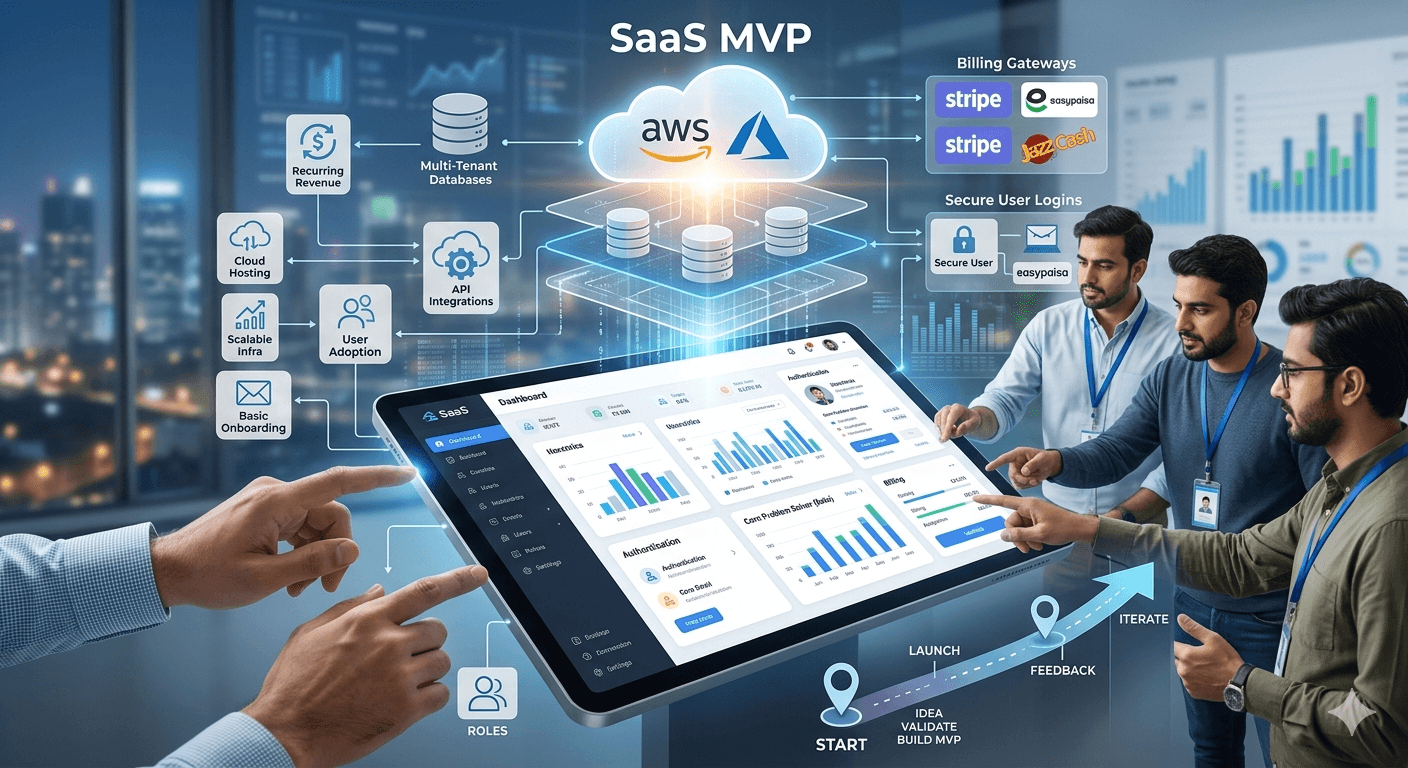
You have an idea for a software product. Maybe it's a tool that solves a problem you've personally faced. Maybe it's a platform for a niche industry no one has served well yet. Maybe you've spotted a gap in the Pakistani market that international tools don't fill.
The instinct most founders have at this point is to build everything — every feature, every integration, every edge case — before launching. That instinct will kill your product before it ever reaches a real user.
The smarter path is an MVP. And if you're building a software business, specifically a SaaS MVP.
This guide explains what that means, what it actually costs in 2026, and how to avoid the mistakes that waste six months and hundreds of thousands of rupees on something nobody ends up using.
What Does SaaS Actually Mean?
SaaS stands for Software as a Service. Instead of software you buy once and install on a computer, SaaS is software delivered over the internet — typically through a web browser or mobile app — and billed on a subscription basis (monthly or annually).
Examples you already use: Google Workspace, Zoom, Shopify, Canva, Trello. All SaaS.
The business model is powerful because:
- Recurring revenue compounds over time as you grow your subscriber base
- No physical distribution — updates deploy instantly to all users
- Scalable infrastructure — cloud hosting grows as your users grow
- Low barrier to adoption — users access it from any device, no installation needed
Building a SaaS product means building something that lives in the cloud, handles multiple users simultaneously, manages subscriptions and billing, and stays online reliably 24/7.
What Is an MVP?
MVP stands for Minimum Viable Product. The term comes from the lean startup methodology and it means exactly what it says: the most stripped-down version of your product that still delivers real value to real users.
The critical word is viable. An MVP is not a broken, half-finished product. It's a focused, fully functional product — just one that does fewer things.
The goal of an MVP is not to impress investors with a feature list. It's to answer one question as cheaply and quickly as possible:
Will real people pay for this?
Until you have paying users, everything else is an assumption. An MVP forces you to test those assumptions before you've spent your entire budget.
What an MVP Is NOT
- A prototype or wireframe (those don't function in production)
- A demo you show at meetings but users can't actually use
- A rushed, buggy version of your full product
- A version with every feature you eventually want to build
SaaS MVP vs Regular MVP
Not all MVPs are SaaS products. You could build an MVP for a mobile app, a hardware device, or even a service business using manual processes (sometimes called a "concierge MVP").
A SaaS MVP specifically means:
- Web-based or app-based software that users access online
- Multi-tenant architecture (multiple customers using the same system, with their data kept separate)
- User authentication (sign up, login, roles and permissions)
- Subscription billing — either manual at first, or integrated with a payment gateway (Stripe, local options like JazzCash/Easypaisa for Pakistan)
- A backend that stores data securely in a database
- Some form of admin panel so you can manage users and monitor activity
This is meaningfully more complex than a static website or a single-use internal tool. That complexity is also why costs vary so widely.

What Features Should a SaaS MVP Include?
This depends entirely on what your product does — but here's a framework to decide what's in and what's out.
Always In (Core Infrastructure)
Every SaaS MVP needs these regardless of what it does:
- User registration, login, and password reset
- Role-based access (e.g., admin vs regular user)
- The core feature set that solves the primary problem
- Basic dashboard or home screen
- Subscription/payment handling (even if manual at first)
- Data security and basic error handling
Usually In (If Central to the Value Proposition)
- Email notifications for key actions
- A simple onboarding flow
- Basic reporting or analytics for the user
- Mobile responsiveness (if users will access on phones)
Leave Out for Now
- Native mobile apps (build web-first)
- Third-party integrations (unless your product literally cannot work without them)
- Advanced analytics and reporting
- AI/ML features
- White-labeling
- API access for developers
- Multi-language support
- Multiple pricing tiers and billing cycles
The feature pruning exercise is the hardest part of MVP planning — and it's where working with an experienced developer pays for itself. Someone who has built SaaS products before will tell you what you genuinely need vs what feels important but isn't.
How Much Does a SaaS MVP Cost to Build in 2026?
This is the question everyone wants answered, and the honest answer is: it depends on scope. But here's a realistic breakdown.
Tier 1: Simple SaaS MVP — PKR 3–7 Lakh (USD 1,000–2,500)
What you get:
- User authentication and basic roles
- 2–4 core features (the single thing your product does)
- Simple dashboard
- Manual billing (you invoice customers yourself)
- Web-based, mobile-responsive
- Basic admin panel
Best for: Solo founders validating a niche idea; internal tools being productized; a very focused workflow tool.
Timeline: 6–10 weeks
Tier 2: Mid-Complexity SaaS MVP — PKR 8–20 Lakh (USD 2,800–7,000)
What you get:
- Full auth system with email verification
- 5–10 features covering a complete user workflow
- Integrated payment gateway (Stripe or local equivalent)
- User onboarding flow
- Email notification system
- Admin panel with user management and basic analytics
- Some third-party integrations (e.g., calendar, CRM, or communication API)
Best for: Founders with a validated idea and some initial users willing to pay; products serving professional users (HR tools, project management, booking platforms).
Timeline: 10–16 weeks
Tier 3: Complex SaaS MVP — PKR 25–60 Lakh (USD 9,000–21,000)
What you get:
- Multi-role system (e.g., admin, manager, end-user, client-facing portal)
- 10–20 features across multiple modules
- Full billing integration with plans and upgrades
- Custom reporting and data visualization
- API integrations with multiple external services
- Mobile app (basic iOS/Android companion)
- Higher-level security and data compliance requirements
Best for: Well-funded startups targeting enterprise clients or regulated industries (fintech, healthtech, logistics).
Timeline: 4–8 months
What Drives Cost Up
- Number of distinct user roles and what each role can do
- Third-party integrations (each one adds development and testing time)
- Real-time features (live chat, notifications, live dashboards)
- Complex business logic (dynamic pricing engines, multi-step workflows)
- Mobile apps built alongside the web platform
- Data-heavy features (bulk imports, reports, analytics)
What Keeps Cost Down
- Starting with manual billing instead of automated subscription management
- Web-only (no mobile app) for the first version
- Avoiding integrations unless absolutely required
- Using proven frameworks and libraries rather than building everything from scratch
- A developer who has built similar products before and doesn't need to figure out the architecture from zero
Pakistan vs International Development Costs: The Real Picture
If you get quotes from development agencies in the US, UK, or Australia for a mid-complexity SaaS MVP, expect USD 25,000–80,000. The same product built by a skilled Pakistani developer or boutique agency runs USD 3,000–15,000.
That difference is real and the quality gap, when you work with the right partner, is minimal. Pakistan has a strong pool of senior full-stack developers who have built production SaaS products for international clients. Many have worked for years on Upwork or for foreign companies, building the same caliber of software at a fraction of the cost.
The risk with local development is inexperience. A freelancer who has built WordPress sites all their career is not equipped to architect a multi-tenant SaaS application. A junior developer who has never managed production infrastructure will cut corners that become catastrophic later.
The questions to ask any developer or agency:
- Can you show me a SaaS product you've built that is live and has real paying users?
- How do you handle multi-tenancy (separating data between customers)?
- What's your approach to deployment and hosting — and who manages it after launch?
- Have you handled subscription billing before?
The Hidden Costs Most Founders Miss
The development bill is only one part of the actual cost to launch a SaaS MVP. Budget for these too:
Hosting and Infrastructure
A basic SaaS MVP on AWS, DigitalOcean, or Render costs PKR 8,000–25,000/month depending on traffic and database size. This is ongoing — not a one-time cost.
Domain and SSL Certificate
Minor but real: PKR 3,000–8,000/year for a professional domain. SSL is often included with modern hosting plans.
Email Service
Transactional emails (signup confirmations, password resets, notifications) need a service like SendGrid or AWS SES. Budget PKR 3,000–10,000/month depending on volume.
Software Development
Next.js vs WordPress: Which Is Better for Your Business Website in 2026?
Payment Gateway Setup
Stripe (for international payments) charges 2.9% + $0.30 per transaction. For Pakistani payments, JazzCash and Easypaisa have their own merchant fee structures. Some gateways also charge a setup or monthly fee.
Post-Launch Maintenance
Software breaks. Browsers update. APIs change. Budget at least PKR 20,000–50,000/month for ongoing maintenance, bug fixes, and minor updates — especially in the first six months after launch.
Design (UI/UX)
If you want a product users actually enjoy using, invest in proper UI/UX design. A designer working on your MVP for 2–4 weeks adds PKR 30,000–100,000 to the budget but dramatically improves conversion and retention.
SaaS MVP Timeline: What Realistic Looks Like
| PhaseWhat HappensDuration | ||
| Discovery & Scoping | Define features, user flows, and tech stack | 1–2 weeks |
| UI/UX Design | Wireframes and visual design | 1–3 weeks |
| Backend Development | Database, APIs, auth, core logic | 4–8 weeks |
| Frontend Development | What users see and interact with | 3–6 weeks |
| Integration & Testing | QA, bug fixes, payment testing | 1–3 weeks |
| Deployment & Go-Live | Production setup, domain, launch | 1 week |
Phases overlap in practice. A realistic total for a mid-complexity SaaS MVP is 10–16 weeks from signed contract to production launch.
Anyone promising a full SaaS product in 3–4 weeks is either oversimplifying the scope or planning to hand you something that collapses under real user load.
The Right Mindset for Building an MVP
Before you spend a single rupee on development, validate your idea. This means:
- Talk to 10–20 potential customers before building. Ask them about their current workflow, what frustrates them, how they solve the problem today.
- Get at least 3 people to say they'd pay for it — not "I'd use it if it were free," but actually committing to a price.
- Start with a landing page describing the product before it's built. See if people sign up for early access.
If you can't get people excited enough to leave their email before you've built anything, reconsider the idea before spending months on development.
What MA Softs Can Build for You
We've built SaaS MVPs for founders across different industries — from HR platforms to booking systems to B2B workflow tools. Our typical engagement looks like this:
- Free scoping call to understand your idea, your users, and your budget
- Detailed proposal with feature list, timeline, and fixed-price quote
- Bi-weekly demos so you see progress and can give feedback throughout
- Handover with documentation — you own everything: code, database, infrastructure
- Optional retainer for ongoing maintenance and feature development
If you have a SaaS idea you're ready to build, let's talk.